their children will sit upon your throne for evermore.”
For the Lord has chosen Zion; *
he has desired her for his habitation:
“This shall be my resting-place for ever; *
here will I dwell, for I delight in her.
I will surely bless her provisions, *
and satisfy her poor with bread.
I will clothe her priests with salvation, *
and her faithful people will rejoice and sing.
There will I make the horn of David flourish; *
I have prepared a lamp for my Anointed.
As for his enemies, I will clothe them with shame; *
but as for him, his crown will shine.”
Psalm 133
Oh, how good and pleasant it is, *
when brethren live together in unity!
It is like fine oil upon the head *
that runs down upon the beard,
Upon the beard of Aaron, *
and runs down upon the collar of his robe.
It is like the dew of Hermon *
that falls upon the hills of Zion.
For there the Lord has ordained the blessing: *
life for evermore.
2 Kings 23:4-25
The king commanded the high priest Hilkiah, the priests of the second order, and the guardians of the threshold, to bring out of the temple of the Lord all the vessels made for Baal, for Asherah, and for all the host of heaven; he burned them outside Jerusalem in the fields of the Kidron, and carried their ashes to Bethel. He deposed the idolatrous priests whom the kings of Judah had ordained to make offerings in the high places at the cities of Judah and around Jerusalem; those also who made offerings to Baal, to the sun, the moon, the constellations, and all the host of the heavens. He brought out the image of Asherah from the house of the Lord, outside Jerusalem, to the Wadi Kidron, burned it at the Wadi Kidron, beat it to dust and threw the dust of it upon the graves of the common people. He broke down the houses of the male temple prostitutes that were in the house of the Lord, where the women did weaving for Asherah. He brought all the priests out of the towns of Judah, and defiled the high places where the priests had made offerings, from Geba to Beer-sheba; he broke down the high places of the gates that were at the entrance of the gate of Joshua the governor of the city, which were on the left at the gate of the city. The priests of the high places, however, did not come up to the altar of the Lord in Jerusalem, but ate unleavened bread among their kindred. He defiled Topheth, which is in the valley of Ben-hinnom, so that no one would make a son or a daughter pass through fire as an offering to Molech. He removed the horses that the kings of Judah had dedicated to the sun, at the entrance to the house of the Lord, by the chamber of the eunuch Nathan-melech, which was in the precincts; then he burned the chariots of the sun with fire. The altars on the roof of the upper chamber of Ahaz, which the kings of Judah had made, and the altars that Manasseh had made in the two courts of the house of the Lord, he pulled down from there and broke in pieces, and threw the rubble into the Wadi Kidron. The king defiled the high places that were east of Jerusalem, to the south of the Mount of Destruction, which King Solomon of Israel had built for Astarte the abomination of the Sidonians, for Chemosh the abomination of Moab, and for Milcom the abomination of the Ammonites. He broke the pillars in pieces, cut down the sacred poles, and covered the sites with human bones. Moreover, the altar at Bethel, the high place erected by Jeroboam son of Nebat, who caused Israel to sin-- he pulled down that altar along with the high place. He burned the high place, crushing it to dust; he also burned the sacred pole. As Josiah turned, he saw the tombs there on the mount; and he sent and took the bones out of the tombs, and burned them on the altar, and defiled it, according to the word of the Lord that the man of God proclaimed, when Jeroboam stood by the altar at the festival; he turned and looked up at the tomb of the man of God who had predicted these things. Then he said, "What is that monument that I see?" The people of the city told him, "It is the tomb of the man of God who came from Judah and predicted these things that you have done against the altar at Bethel." He said, "Let him rest; let no one move his bones." So they let his bones alone, with the bones of the prophet who came out of Samaria. Moreover, Josiah removed all the shrines of the high places that were in the towns of Samaria, which kings of Israel had made, provoking the Lord to anger; he did to them just as he had done at Bethel. He slaughtered on the altars all the priests of the high places who were there, and burned human bones on them. Then he returned to Jerusalem. The king commanded all the people, "Keep the passover to the Lord your God as prescribed in this book of the covenant." No such passover had been kept since the days of the judges who judged Israel, or during all the days of the kings of Israel or of the kings of Judah; but in the eighteenth year of King Josiah this passover was kept to the Lord in Jerusalem. Moreover Josiah put away the mediums, wizards, teraphim, idols, and all the abominations that were seen in the land of Judah and in Jerusalem, so that he established the words of the law that were written in the book that the priest Hilkiah had found in the house of the Lord. Before him there was no king like him, who turned to the Lord with all his heart, with all his soul, and with all his might, according to all the law of Moses; nor did any like him arise after him.
1 Cor. 12:1-11
Now concerning spiritual gifts, brothers and sisters, I do not want you to be uninformed. You know that when you were pagans, you were enticed and led astray to idols that could not speak. Therefore I want you to understand that no one speaking by the Spirit of God ever says "Let Jesus be cursed!" and no one can say "Jesus is Lord" except by the Holy Spirit. Now there are varieties of gifts, but the same Spirit; and there are varieties of services, but the same Lord; and there are varieties of activities, but it is the same God who activates all of them in everyone. To each is given the manifestation of the Spirit for the common good. To one is given through the Spirit the utterance of wisdom, and to another the utterance of knowledge according to the same Spirit, to another faith by the same Spirit, to another gifts of healing by the one Spirit, to another the working of miracles, to another prophecy, to another the discernment of spirits, to another various kinds of tongues, to another the interpretation of tongues. All these are activated by one and the same Spirit, who allots to each one individually just as the Spirit chooses.
Matt. 9:18-26
While he was saying these things to them, suddenly a leader of the synagogue came in and knelt before him, saying, "My daughter has just died; but come and lay your hand on her, and she will live." And Jesus got up and followed him, with his disciples. Then suddenly a woman who had been suffering from hemorrhages for twelve years came up behind him and touched the fringe of his cloak, for she said to herself, "If I only touch his cloak, I will be made well." Jesus turned, and seeing her he said, "Take heart, daughter; your faith has made you well." And instantly the woman was made well. When Jesus came to the leader's house and saw the flute players and the crowd making a commotion, he said, "Go away; for the girl is not dead but sleeping." And they laughed at him. But when the crowd had been put outside, he went in and took her by the hand, and the girl got up. And the report of this spread throughout that district.
Passion is at the at the root of our energy for ministry. It is that God-given quality that enthuses us with clarity of vision and depth of conviction. It moves us when we see the suffering of other people. It drives us when we understand what is to be done about it. Without passion, we whither.
With vibrant passion we can overcome obstacles and rise above our moods. Passion reminds us of our essential purpose and drives us forward. Some characteristics of passionate people are at https://medium.com/@tomsims/take-eat-drink-25fc071c9170
There is also a fair share of discouragement, bad attitudes, and poor behavior.
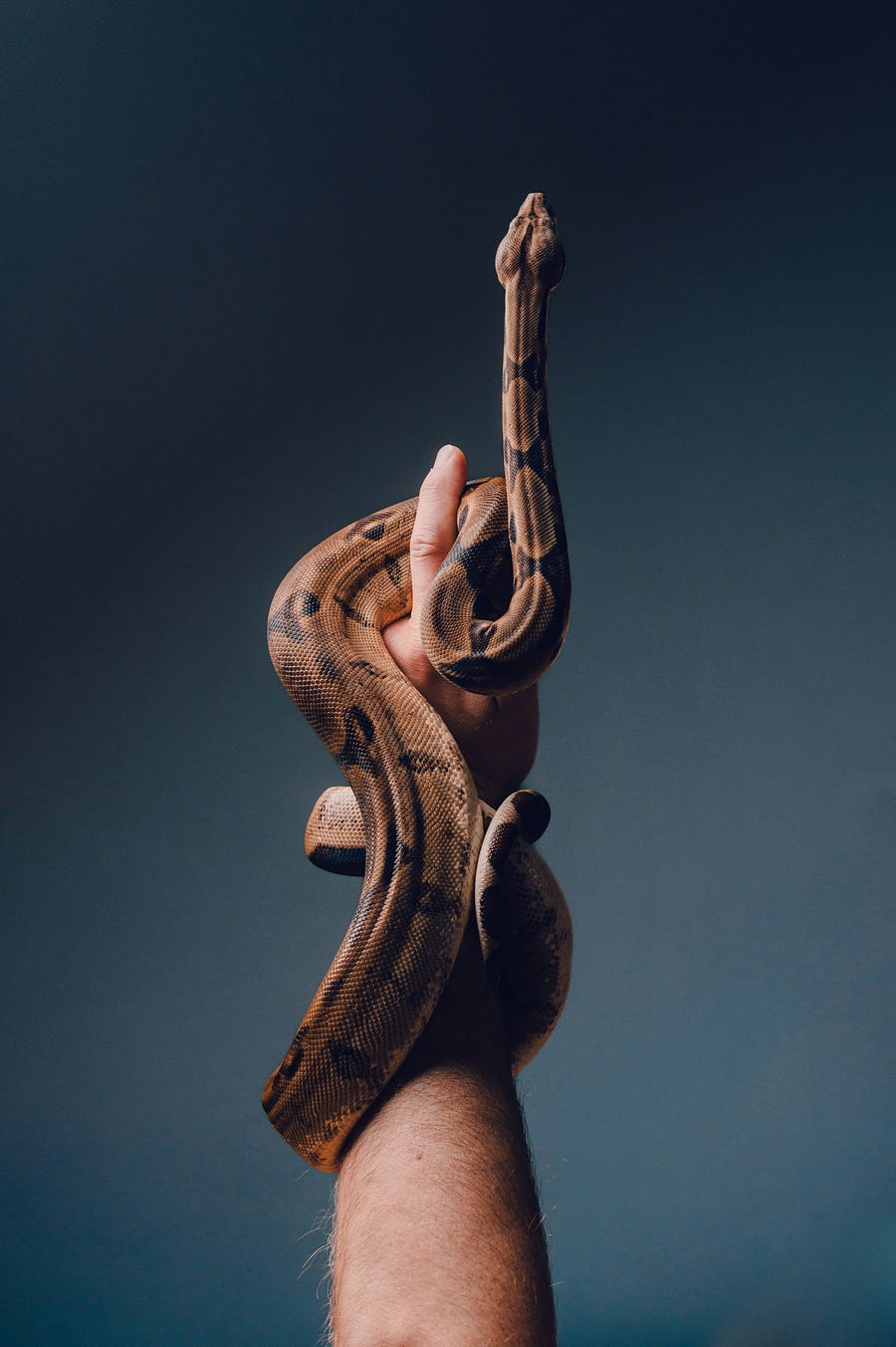
There is also a salvation story, and a snake is involved in that too.
Some people are fascinated by snakes. Others are fearful.
The first snake in the Bible is not presented in a very good light. He comes as a tempter, offering an eye-opening experience.
We’ve been tempted by snakes, bitten by them, cut off their heads, and have thrown them in the fire.
But God made snakes and God made everything.
There are snakes in the story I am about to read you. They come in a context of discouragement and complaining, but they also remind us that there is more to the story than we often see up front.
Numbers 21:4–9 — (New Revised Standard Version Updated Edition)
From Mount Hor they set out by the way to the Red Sea, to go around the land of Edom, but the people became discouraged on the way.
We get easily discouraged. When we get discouraged, we often complain. When we complain, we look for scapegoats upon which to assign our blame.
The lives of the people had been seriously disrupted, but it was part of their liberation, redemption, and hope.
But their bellies were empty, and their prospects were seemingly bleak. So, they got crotchety and out of sorts and they needed to learn some things.
The people spoke against God and against Moses, “Why have you brought us up out of Egypt to die in the wilderness? For there is no food and no water, and we detest this miserable food.”
They did not like the food and there was not enough as far as they were concerned. God was providing, but they were dissatisfied.
They thought they were going to die.
They blamed God and they blamed God’s prophet, Moses.
We are chronic blamers.
So, God, knowing that it was necessary for them to learn some important lessons as part of the process of saving them, sent snakes.
Then the Lord sent poisonous serpents among the people, and they bit the people, so that many Israelites died.
The snakes’ bit some of them and they died.
Now, get out-of-sorts with this if you must, but if it were not for the people learning this lesson, they would have all died. And … we do all die…some time.
Don’t get mad at God about the lived-out-story.
You and I do not know the whole story.
Good storytellers like God and Moses only tell you the pertinent parts, the parts that drive home the lesson.
The people came to Moses and said, “We have sinned by speaking against the Lord and against you; pray to the Lord to take away the serpents from us.”
Now they start learning. They are now ready to stop blaming and start taking responsibility for their own choices and attitudes.
“Please take away the snakes.”
How did God answer?
So, Moses prayed for the people. And the Lord said to Moses, “Make a poisonous serpent, and set it on a pole, and everyone who is bitten shall look at it and live.”
First, God had already started to answer. He had an intercessor in place: Moses. Moses prayed. We do not know what he prayed, but we know for whom he prayed.
Then, God provided an answer, but it was not what the people had requested.
God did not take away the snakes.
There will always be snakes among us, for good and for bad.
So, Moses made a serpent of bronze and put it upon a pole, and whenever a serpent bit someone, that person would look at the serpent of bronze and live.
God transformed the curse into the sign of salvation. He used the bronze serpent to direct the attention of the people back to himself seeking salvation.
Look and live.
Snakes bite, but even in Genesis, snakes that bruise end up getting crushed. Metaphors live in the land of transforming meaning and redemptive purpose and God is always taking us along the road of progressive revelation in scripture until Jesus comes and shows us the serpent in the light of his own redemptive purpose.
Listen to these words from the gospel.
Listen, all ye who are discouraged and complaining.
Listen, all ye who are dissatisfied and disdainful.
Listen before you build your own idols and altars to the false gods that wear righteous garments to deceive you in the gardens and deserts of your lives.
John 3:13–17 — New Revised Standard Version Updated Edition
No one has ascended into heaven except the one who descended from heaven, the Son of Man. And just as Moses lifted up the serpent in the wilderness, so must the Son of Man be lifted up, that whoever believes in him may have eternal life.
“For God so loved the world that he gave his only Son, so that everyone who believes in him may not perish but may have eternal life.
“Indeed, God did not send the Son into the world to condemn the world but in order that the world might be saved through him.
Here, Jesus takes the role of the golden serpent.
Jesus starts by telling us that no one knows everything about God. No one’s gone to heaven to really Get it all. No one’s got all the answers. No one has arrived.
He puts it this way: No one has ascended into heaven except the one who descended from heaven, the Son of Man. And just as Moses lifted up the serpent in the wilderness, so must the Son of Man be lifted up, that whoever believes in him may have eternal life.
There’s pause, look and live. Look and live. Look to the one who lived among us, but descended from above us.
Next verse: for God so loved the world that he gave his only son, that whoever believes in him may not perish, have eternal life.
Humanity proceeds from God, but so does divinity, so does salvation.
God made snakes, but God created a plan.
Next verse, indeed, God did not send his son to the world to condemn the but in order that the world might be saved from him.
Here, Jesus takes the role of the bronze serpent, and we are to look and live.
Like the serpent was lifted up in the wilderness, so is Jesus about to be lifted up on the cross from God.
God is coming among the people, and God is making the sacrifice, and God is turning the curse into the cure, and God is taking the same snake that symbolizes the bite and the venom around us and turning it into the symbol and the means of hope and redemption and salvation, forgiveness, and grace.
Look and live.
Even if you’ve been bitten by the snake, God doesn’t take away the snakes in our lives.
God doesn’t take away the problems in our lives. God transforms them. He uses them.
Jesus is the central figure in this story of redemption. You have a story in the wilderness, and you don’t know the whole story, but in Jesus, you get the whole story.
You get the completion.
You find the author and the finisher of our faith.
You find the redeemer.
You find the one who comes as God man to sacrifice for us, the bridge between God and man, the key. The one who holds the keys is the key.
The one who opens the door is the door.
The one who comes among the sheep to be the shepherd, to lead us look and live, look and live.
There are many problems in the world. Problems come and problems go.
I don’t know if you know this or not, but your country, my country is America. And your country may be Nigeria or Kenya or India, Pakistan or some other place, Senegal, Canada.
Your country is not the center of the world, and the world is not the center of the universe.
Your time, our time, is not the center of history.
What’s going on around you is not the be all end all of everything.
What happens in America is not the core of every interpretation of the meaning of our existence. Our time is not the center of time, and our problems are not the only snakes in history, and especially in the history of salvation.
Lots of snakes Lots of snakes that wear righteous clothing.
Lots of snakes that talk the talk.
Lots of snakes that come amidst our complaining and blaming and looking to God and the prophets and the circumstances and stirring up our discouragement and dissatisfaction, but even so, in the midst of it all, as we’re getting bitten by the snakes, we’re not at the center of things.
No, there’s a serpent, a bronze serpent on a pole, crying out, “Look and live, look and live.”
Somehow or another, we need to come out of that snake infested pit of our own time and our own making and our own attitudes and our own bickering and dickering and our own dissatisfaction with the way things are, and look to God and God’s Son and God’s redemption and live.
We need to change the direction of our view. We need to change our focus. We need to change our attitudes.
In looking, the Israelites were believing. They were trusting. They were committing to a new center, to a new reality.
You haven’t been to heaven yet, so you don’t know it all. There is one who has descended from heaven that says, look at me and live. That’s the message. That’s the call to action.
Look and live.
Don’t look at the snakes on the ground. Don’t look at the desert. Don’t look at your wants and needs. Don’t get caught up in the discouragement of the moment. Look up to the serpent on the pole.
Look to Jesus and live. May the Lord bless you and keep you.
In this message, we focused on a biblical narrative involving snakes, discouragement, and redemption, drawing from Numbers 21:4–9 and John 3:13–17. We considered the Israelites’ journey, their complaints against God and Moses, and the subsequent sending of poisonous snakes as a lesson.
The core message was about transformation and redemption, as God instructed Moses to create a bronze serpent for the people to look at and be healed, symbolizing salvation through faith.
We connected this to the New Testament, where Jesus is likened to the bronze serpent, emphasizing the importance of looking to Jesus for salvation and redemption. We beheld themes of faith, responsibility, and the transformative power of God, and were reminded to shift our focus from worldly problems to divine solutions.
We concluded with a call to action to “look and live,” encouraging a change in perspective towards faith and redemption.